Why Node.js is Perfect for Building Fast Web Applications
Learn why Node.js handles high concurrency so effectively, and where Node.js performs best in real-world applications.
Node.js isn't fast because of raw processing power. It's fast because it never waits around when there's work to do. This post covers the architectural decisions that make Node.js well-suited for high-concurrency web applications.
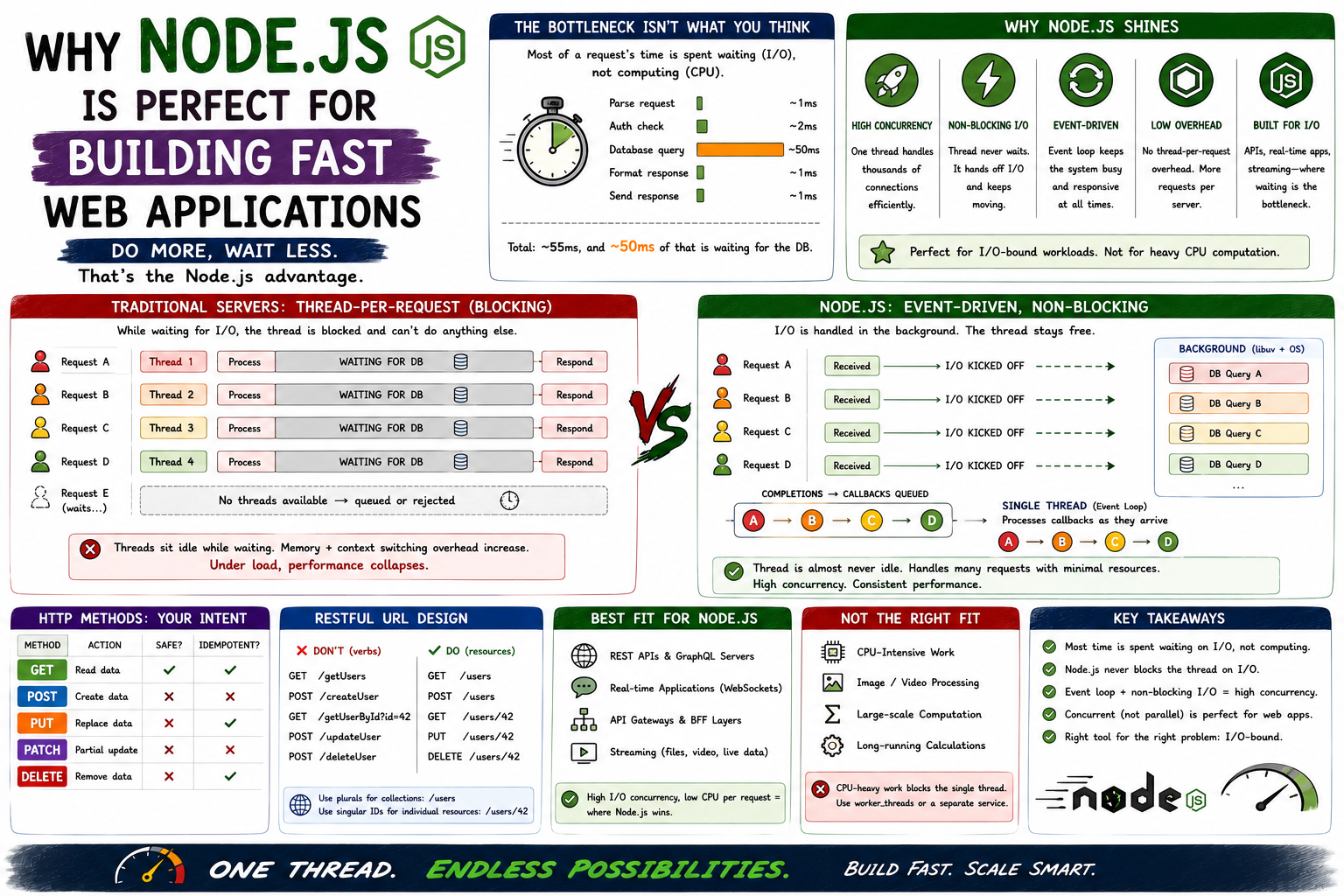
Speed in web servers is rarely about CPU performance. A database query doesn't go faster because you have a more powerful processor. An API call to a third-party service doesn't come back sooner because you upgraded RAM. Most of a request's lifetime is spent waiting: waiting for the database, waiting for the network, waiting for the disk. The server that handles the most requests is the one that makes the best use of that waiting time. That's what Node.js is optimized for.
The Bottleneck Isn't What You Think
When a user hits your API, the server's job breaks down roughly like this:
Typical API request timeline:

Parse request        [■] ~1ms
Auth check           [■■] ~2ms
Database query       [■■■■■■■■■■■■■■■■■■■■■■■■] ~50ms
Format response      [■] ~1ms
Send response        [■] ~1ms
                      ─────────────────────────
Total: ~55ms, and ~50ms of that is waiting for the DB
The computation is cheap. The I/O is expensive. A server's performance under load depends almost entirely on how it handles that 50ms of waiting time when dozens or hundreds of requests are arriving concurrently.
How Traditional Servers Handle This
Most traditional web servers follow a thread-per-request model. A request comes in, a thread is assigned, that thread handles the request start to finish, and then it's freed. While the thread is waiting for the database, it sits blocked, doing nothing, but still consuming memory and CPU scheduling resources.
Thread-per-request model: 4 requests arrive simultaneously

Thread 1: [Req A ─────────────── waiting for DB ──────────── respond]
Thread 2: [Req B ─────────────── waiting for DB ──────────── respond]
Thread 3: [Req C ─────────────── waiting for DB ──────────── respond]
Thread 4: [Req D ─────────────── waiting for DB ──────────── respond]

Request 5 arrives → no threads available → queued or rejected
This scales to a point. More requests mean more threads. More threads mean more memory, more context switching overhead, and eventually a hard ceiling where the OS can no longer efficiently manage the thread count.
How Node.js Handles This
Node.js runs JavaScript on one thread. One. But it never blocks that thread on I/O.
Think of a restaurant with one highly efficient waiter. The waiter takes your order, hands it to the kitchen, and immediately takes the next table's order. They don't stand at the kitchen pass staring at your food until it's ready. When it is ready, they come back and deliver it. One person, many tables, constant forward progress.
Node.js event-driven model: 4 requests arrive simultaneously

Single Thread:
  Req A arrives → DB query kicked off → thread moves on
  Req B arrives → DB query kicked off → thread moves on
  Req C arrives → DB query kicked off → thread moves on
  Req D arrives → DB query kicked off → thread moves on

Background (libuv + OS):
  [DB query A ─────── completes] → callback queued
  [DB query B ─────── completes] → callback queued
  [DB query C ─────── completes] → callback queued
  [DB query D ─────── completes] → callback queued

Thread processes callbacks as they arrive:
  [A response][B response][C response][D response]
All four queries run concurrently at the OS level. The single thread is free during all of that. It only comes back when there's something it actually needs to do: handle the result.
Non-Blocking I/O: The Core Mechanism
Non-blocking I/O means the thread doesn't wait for an I/O operation to complete before moving on. It registers the operation, attaches a callback, and continues. When the operation completes, the result gets queued and the callback runs when the thread is free.
// Blocking: thread stops here until file is fully read
const data = fs.readFileSync("./data.json");

// Non-blocking: thread registers the read and continues
fs.readFile("./data.json", (err, data) => {
  // runs when the file is ready
});

// This line runs immediately, before the file is done reading
processNextRequest();
This isn't just a code style choice. It's the reason Node.js can handle thousands of concurrent connections with a single thread. Every database query, every file read, every outgoing HTTP request is non-blocking. The thread is almost never idle, and it's almost never blocked.
Event-Driven Architecture
Node.js is built around events. Things happen (a request arrives, a file read completes, a timer fires), and handlers run in response. The event loop continuously checks: "Has anything completed? Is there a callback to run?"
Event Loop Cycle:

  ┌──────────────────────────────────────────┐
  │                                          │
  │  Are there timers ready to fire?         │
  │  Are there I/O callbacks waiting?        │
  │  Is there other queued work?             │
  │                                          │
  │  Yes → run the next callback             │
  │  No  → wait for something to arrive      │
  │                                          │
  └──────────────────────────────────────────┘
          ↑                   ↓
          └───── repeat ──────┘
This model makes Node.js naturally suited for applications where work arrives unpredictably and concurrently: HTTP APIs, WebSocket servers, real-time features, message queue consumers.
Concurrency vs Parallelism
These terms get conflated. The difference matters here.
Parallelism is doing multiple things at the same time, literally, on multiple CPU cores simultaneously. That requires multiple threads or processes.
Concurrency is managing multiple things at once by switching attention efficiently. You make progress on all of them without necessarily running them at the same literal instant.
Node.js is concurrent, not parallel for JavaScript execution. The single thread interleaves work by never blocking. For most web applications, which are I/O-bound, concurrency is what you actually need. Parallelism only helps if you're doing heavy computation.
Where Node.js Performs Best
Node.js isn't the right tool for every problem. It's the right tool for a specific class:
REST APIs and GraphQL servers: The dominant use case. Requests are largely I/O bound. Node.js handles them efficiently and the JSON-native nature of JavaScript makes API development fast.
Real-time applications: Chat apps, collaborative tools, live notifications. WebSocket connections stay open. Node.js handles thousands of simultaneous open connections with low overhead because an idle connection doesn't block anything.
API gateways and BFF layers: Aggregating data from multiple services and shaping it for a client. Mostly outgoing I/O, minimal computation. Node.js shines here.
Streaming: Video, file uploads, live data feeds. Node.js has first-class streaming primitives that handle large data without loading everything into memory.
Node.js is the wrong tool for CPU-intensive work: image processing, video transcoding, large-scale numerical computation. A long-running computation occupies the single thread, and every other request waits.
Real-World Validation
Companies with some of the highest-traffic APIs in the world use Node.js:
- Netflix moved their UI rendering layer to Node.js and cut startup time significantly.
- LinkedIn switched their mobile backend from Ruby on Rails to Node.js and went from 15 servers to 4 while doubling traffic.
- PayPal rewrote their account overview page in Node.js and handled twice as many requests per second compared to the Java version, with 35% fewer servers.
- Uber built their core trip system on Node.js to handle massive real-time concurrency.
The pattern is consistent: applications with high I/O concurrency and relatively low computation per request see strong gains.
Key Takeaways
- Most of an API request's time is spent waiting on I/O, not computing. Node.js is optimized for that waiting time.
- Non-blocking I/O means the thread never sits idle waiting for a database or file. It moves on and comes back when the result is ready.
- The event loop manages what runs next: always something, never blocked.
- Node.js is concurrent (efficient interleaving on one thread), not parallel. For I/O-bound workloads, that's what actually matters.
- Best fit: REST APIs, real-time apps, API gateways, streaming. Wrong fit: heavy CPU computation.
Node.js doesn't win because it's the fastest runtime on benchmarks. It wins because it makes the architecture of I/O-heavy applications simpler and its single-threaded, non-blocking model naturally handles concurrency that would require significant thread management in other runtimes.