What is Middleware in Express and How It Works
Learn how Express middleware works, what next() does, the types of middleware, auth, and validation.
Middleware is code that runs between a request arriving and a response being sent. In Express, every middleware function in the chain gets a chance to inspect, modify, or stop a request. This post covers what middleware is, how `next()` controls the flow, and where it gets used in real applications.
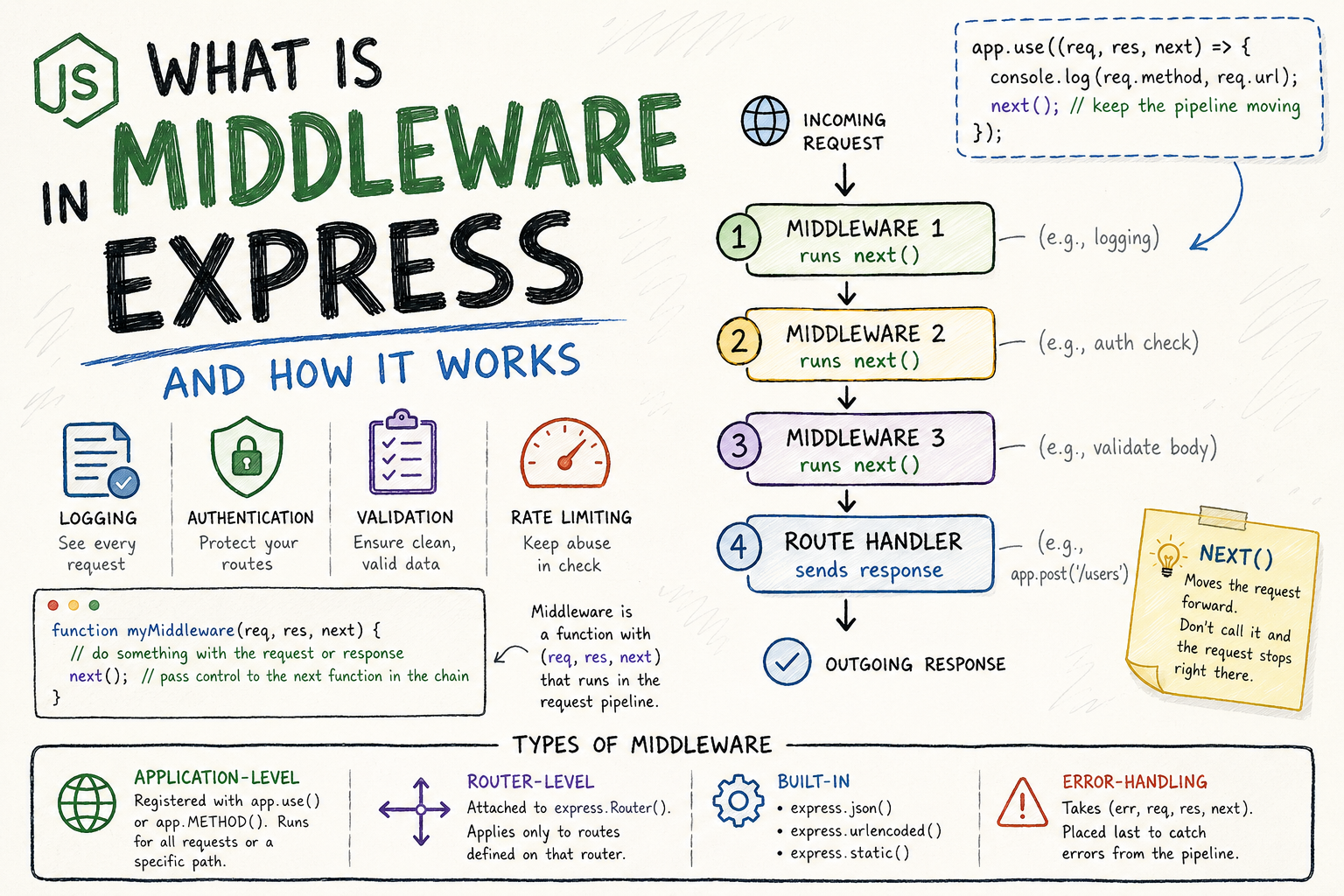
Every HTTP request your Express server receives goes through a pipeline before it reaches your route handler. Middleware is everything that lives in that pipeline. It's not a special category of code - it's a function with access to the request, the response, and the ability to either pass control forward or stop the chain. Logging, authentication, body parsing, rate limiting: all of it is middleware.
What a Middleware Function Looks Like
A middleware function takes three arguments: req, res, and next.
function myMiddleware(req, res, next) {
  // do something with the request or response
  next(); // pass control to the next function in the chain
}
That's it. The shape is identical to a route handler. The difference is that middleware calls next() to continue the chain, while a route handler typically ends it by sending a response.
Where Middleware Sits
 Incoming Request
         │
         ▼
┌─────────────────┐
│  Middleware 1   │  (e.g., logging)
│  runs next()    │
└────────┬────────┘
         │
         ▼
┌─────────────────┐
│  Middleware 2   │  (e.g., auth check)
│  runs next()    │
└────────┬────────┘
         │
         ▼
┌─────────────────┐
│  Middleware 3   │  (e.g., validate body)
│  runs next()    │
└────────┬────────┘
         │
         ▼
┌─────────────────┐
│  Route Handler  │  (e.g., app.post('/users'))
│  sends response │
└────────┬────────┘
         │
         ▼
 Outgoing Response
Each middleware runs in the order it was registered. If any middleware doesn't call next(), the chain stops there. If none of them send a response, the request hangs.
The Role of next()
next() is what moves a request forward. Call it and control passes to the next middleware or route handler. Don't call it and the request stops exactly where it is.
// This middleware logs every request and moves on
app.use((req, res, next) => {
  console.log(`${req.method} ${req.url}`);
  next(); // without this, nothing after runs
});

// This middleware checks auth and can short-circuit
app.use((req, res, next) => {
  const token = req.headers.authorization;
  if (!token) {
    return res.status(401).json({ error: "Unauthorized" }); // stops here
  }
  next(); // valid token, continue
});
In the auth example, an invalid token sends a 401 response and never calls next(). The route handler below never runs. This is the pattern for any middleware that acts as a gate.
Calling next(error) is also valid. It skips all remaining regular middleware and jumps to an error-handling middleware if one exists.
Types of Middleware
Application-Level Middleware
Registered with app.use() or app.METHOD(). It runs for every request to the app, or for requests matching a specific path.
// Runs for every single request
app.use((req, res, next) => {
  req.requestTime = Date.now();
  next();
});

// Runs only for requests starting with /api
app.use("/api", (req, res, next) => {
  console.log("API request received");
  next();
});
Router-Level Middleware
Same as application-level but attached to an express.Router() instance. Useful for grouping middleware that should only apply to a subset of routes.
const router = express.Router();

// Applies only to routes defined on this router
router.use(authenticate);
router.use(validateInput);

router.get('/profile', (req, res) => { ... });
router.put('/settings', (req, res) => { ... });
If authenticate is only needed for protected routes, attaching it to a router keeps it scoped. Global middleware on app.use() runs for everything, which you don't always want.
Built-In Middleware
Express ships with a few middleware functions ready to use:
app.use(express.json()); // parses JSON request bodies → req.body
app.use(express.urlencoded({ extended: true })); // parses form data
app.use(express.static("public")); // serves static files from /public
express.json() is the one you'll use in virtually every API. Without it, req.body is undefined on POST requests.
Execution Order Matters
Middleware runs in the order it's registered. Register it in the wrong order and it either doesn't apply or causes bugs.
// WRONG: route runs before auth check
app.get("/dashboard", getDashboard);
app.use(authenticate); // never reached for /dashboard

// RIGHT: auth check registered before the route
app.use(authenticate);
app.get("/dashboard", getDashboard);
A common real-world order looks like this:
app.use(express.json()); // 1. Parse body first
app.use(requestLogger); // 2. Log every request
app.use("/api", authenticate); // 3. Auth for protected routes
app.use("/api", router); // 4. Route handlers
app.use(errorHandler); // 5. Error middleware last
Real-World Examples
Request logging:
function requestLogger(req, res, next) {
  const start = Date.now();
  res.on("finish", () => {
    const ms = Date.now() - start;
    console.log(`${req.method} ${req.url} ${res.statusCode} - ${ms}ms`);
  });
  next();
}
Hooks into the response finish event so it logs after the response is sent, capturing the actual status code.
Authentication:
function authenticate(req, res, next) {
  const authHeader = req.headers.authorization;
  if (!authHeader?.startsWith("Bearer ")) {
    return res.status(401).json({ error: "Token required" });
  }
  try {
    const token = authHeader.split(" ")[1];
    req.user = jwt.verify(token, process.env.JWT_SECRET);
    next();
  } catch {
    res.status(401).json({ error: "Invalid token" });
  }
}
Attaches req.user so every downstream route handler knows who's asking without re-verifying the token.
Request validation:
function validateCreateUser(req, res, next) {
  const { name, email } = req.body;
  if (!name || !email) {
    return res.status(400).json({ error: "name and email required" });
  }
  if (!email.includes("@")) {
    return res.status(400).json({ error: "Invalid email format" });
  }
  next();
}

app.post("/users", validateCreateUser, createUser);
Keeping validation in middleware means createUser receives clean, validated input and never needs to handle bad data. The responsibilities are separated.
Multiple Middleware on One Route
You can pass multiple middleware functions directly to a route:
app.post(
  "/users",
  authenticate, // must be logged in
  validateCreateUser, // must send valid data
  createUser, // actually create the user
);
Each function runs in order. If any of them send a response, the rest don't run. This is the cleanest way to compose route-specific logic without putting everything inside one handler.
Key Takeaways
- Middleware is a function with
(req, res, next)that runs between the request arriving and the response being sent. next()passes control forward. Without it, the chain stops.next(error)jumps to the error handler.- Register application-level middleware with
app.use(). Useexpress.Router()to scope middleware to specific route groups. - Order matters. Body parsers and loggers go first. Auth middleware before protected routes. Error handlers last.
- Logging, authentication, and validation are the three most common real-world uses. Each one belongs in its own middleware function, not mixed into route handlers.
Middleware is the mechanism that keeps Express applications clean and composable. Once you think in terms of the pipeline - each function doing one thing and passing the request forward - route handlers become simple and business logic stays testable.