`this` and `globalThis` in Node.js: What They Really Are
A complete guide to how `this` behaves in every Node.js context, from top-level module scope to classes and arrow functions.
`this` is one of JavaScript's most misunderstood keywords, and Node.js adds its own twists on top. This post breaks down exactly how `this` behaves in every context you'll encounter, why `globalThis` exists, and the subtle gotchas that catch even experienced developers off guard.
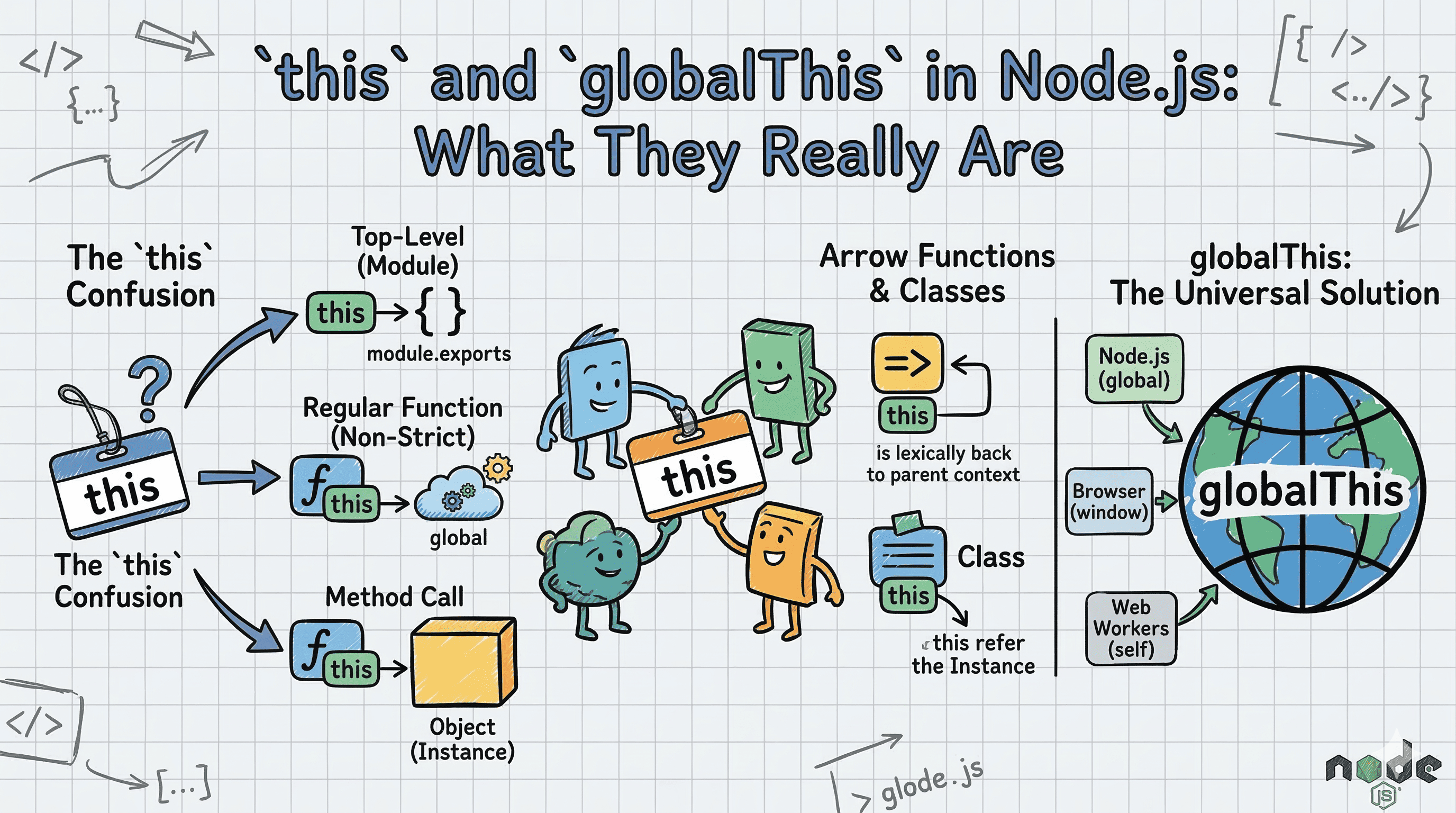
Think of this like a name tag at a company event. The name tag doesn't belong to any one person permanently. Whoever is wearing it at that moment is the person it refers to. Pass the name tag to someone else, and now "this person" is someone different entirely. this in JavaScript works exactly the same way. It doesn't care where a function was written. It cares about how and where that function was called.
Simple enough in theory. In practice, Node.js throws in a few surprises.
What this Actually Refers To
Before anything else, there's one rule that anchors everything:
thisis determined by the call site, not the definition site.
That single rule explains most of the confusion people have. Let's go through each context one by one.
this at the Top Level of a Node.js File
Here's something most developers get wrong the first time.
Open any Node.js file and log this at the very top:
// file: index.js
console.log(this); // {}
console.log(this === module.exports); // true
console.log(this === global); // false
That empty object? That's module.exports. Not global. Not window. Not the module itself. It's module.exports.
Here's why. Node.js doesn't run your files as-is. It wraps every file in a function before executing it. This is the module wrapper:
┌────────────────────────────────────────────────────────┐
│  Node.js Module Wrapper                                │
│                                                        │
│  (function(exports, require, module, __filename,       │
│            __dirname) {                                │
│                                                        │
│    // YOUR FILE CODE RUNS HERE                         │
│                                                        │
│    console.log(this); // <-- this = module.exports     │
│                                                        │
│  });                                                   │
└────────────────────────────────────────────────────────┘
Because your code is wrapped in a regular function and called with this set to module.exports, that's what you see at the top level. This surprises a lot of people who expect this to be global here. It isn't.
If you reassign this at the top level, you're actually modifying module.exports:
this.name = "Atharv";
console.log(module.exports); // { name: 'Atharv' }
this Inside Regular Functions
Now step inside a function definition. The behavior changes, and it depends on strict mode.
┌─────────────────────────────────────────────┐
│         Function Call Context               │
│                                             │
│  Non-strict mode:                           │
│    function foo() { this → global }         │
│                                             │
│  Strict mode ('use strict'):                │
│    function foo() { this → undefined }      │
│                                             │
│  Method call:                               │
│    obj.foo()  →  this = obj                 │
└─────────────────────────────────────────────┘
In non-strict mode, calling a plain function gives you global as this:
function showThis() {
  console.log(this === global); // true
}

showThis();
In strict mode (or in ES modules, which are always strict), this becomes undefined:
"use strict";

function showThis() {
  console.log(this); // undefined
}

showThis();
This is actually the safer behavior. Accidentally attaching things to global through a function call is a classic source of bugs.
this in Methods
When a function is called as a method of an object, this becomes that object. This is the most intuitive use case.
const user = {
  name: "Atharv",
  greet() {
    console.log(`Hello, ${this.name}`);
  },
};

user.greet(); // Hello, Atharv
But here's the catch. Detach that method from the object and this changes:
const greet = user.greet;
greet(); // Hello, undefined (or crashes in strict mode)
The function is the same. The call site changed. That's all it takes.
┌──────────────────────────────────────────────────┐
│  user.greet()          │  greet()                │
│  this = user           │  this = global / undef  │
│  "Hello, Atharv"       │  "Hello, undefined"     │
└──────────────────────────────────────────────────┘
This is exactly why React developers used to write this.handleClick = this.handleClick.bind(this) in constructors. And why arrow functions became so popular for event handlers.
Arrow Functions: Lexical this
Arrow functions don't have their own this. They capture it from the surrounding scope at the time they were defined. This is called lexical binding.
const user = {
  name: "Atharv",
  greetLater() {
    setTimeout(function () {
      console.log(this.name); // undefined, this = global/undefined
    }, 100);

    setTimeout(() => {
      console.log(this.name); // "Atharv", this = user
    }, 100);
  },
};

user.greetLater();
The arrow function inside setTimeout doesn't create its own this. It looks up the scope chain and finds this from greetLater, which is user.
┌───────────────────────────────────────────────┐
│  Arrow Function: Lexical this                 │
│                                               │
│  Outer scope (greetLater called on user)      │
│  this = user                                  │
│      │                                        │
│      └──> Arrow function inherits this        │
│           this = user  (same object)          │
└───────────────────────────────────────────────┘
One thing to watch out for: don't use arrow functions as object methods if you need this to refer to the object. Since they capture this lexically, you'll get the outer this instead.
const user = {
  name: "Atharv",
  greet: () => {
    console.log(this.name); // undefined, this is NOT user here
  },
};
this in Classes
Inside a class, this refers to the instance of that class. This is the most predictable context.
class Counter {
  constructor() {
    this.count = 0;
  }

  increment() {
    this.count++;
    console.log(this.count);
  }
}

const c = new Counter();
c.increment(); // 1
c.increment(); // 2
But even here, the "detached method" problem applies. If you pass c.increment as a callback, this will be lost unless you bind it or use an arrow function property.
// This breaks:
setTimeout(c.increment, 1000); // NaN

// Fix with bind:
setTimeout(c.increment.bind(c), 1000); // 1

// Or use a class field (arrow function):
class Counter {
  count = 0;
  increment = () => {
    this.count++;
    console.log(this.count);
  };
}
The global Object in Node.js
Every runtime has a global object. In browsers, it's window. In Node.js, it's global.
The global object holds things like setTimeout, setInterval, console, process, and Buffer. When you call console.log(), you're technically calling global.console.log().
┌──────────────────────────────────────────┐
│            Node.js global object         │
│                                          │
│  global.console      → Console           │
│  global.setTimeout   → Function          │
│  global.process      → Process           │
│  global.Buffer       → Buffer class      │
│  global.queueMicrotask → Function        │
│  global.__filename   → NOT here (module) │
│  global.__dirname    → NOT here (module) │
└──────────────────────────────────────────┘
A quick gotcha: __filename and __dirname are NOT on global. They're injected by the module wrapper and are only available inside each file's scope.
Variables you declare with var in a function do NOT automatically attach to global in Node.js (unlike in browsers where top-level var becomes window.x). In Node.js, file-level var stays inside the module wrapper.
globalThis: The Universal Answer
Here's the problem globalThis was created to solve.
JavaScript runs in different environments. Each has its own name for the global object:
┌─────────────────────────────────────────────┐
│  Environment     │  Global Object Name      │
├──────────────────┼──────────────────────────┤
│  Browser         │  window                  │
│  Node.js         │  global                  │
│  Web Workers     │  self                    │
│  Deno            │  globalThis              │
└─────────────────────────────────────────────┘
If you're writing code that needs to work across environments (think: a library, a shared utility), you'd have to write something like:
// The old painful way
const globalObj =
  typeof window !== "undefined"
    ? window
    : typeof global !== "undefined"
      ? global
      : typeof self !== "undefined"
        ? self
        : undefined;
That's ugly. globalThis, introduced in ES2020, fixes this cleanly. It always refers to the global object, regardless of environment.
// Works everywhere: Node.js, browser, worker
console.log(globalThis === global); // true in Node.js
console.log(globalThis === window); // true in browser
┌─────────────────────────────────────────┐
│ globalThis │
│ │
│ Node.js ──────────────────→ global │
│ Browser ──────────────────→ window │
│ Worker ──────────────────→ self │
│ Deno ──────────────────→ Deno's │
│ global │
└─────────────────────────────────────────┘In day-to-day Node.js code, you probably won't reach for globalThis that often. But the moment you start writing isomorphic code (code that runs on both server and client), it becomes essential.
Putting It All Together
Here's a mental map of every this context in Node.js:
┌─────────────────────────────────────────────────────────┐
│  Context                    │  Value of this            │
├─────────────────────────────┼───────────────────────────┤
│  Top-level (CJS file)       │  module.exports ({})      │
│  Top-level (ES module)      │  undefined                │
│  Regular function (sloppy)  │  global                   │
│  Regular function (strict)  │  undefined                │
│  Arrow function             │  Lexically inherited      │
│  Method call (obj.fn())     │  obj                      │
│  Class method               │  Instance                 │
│  Detached method            │  global / undefined       │
└─────────────────────────────┴───────────────────────────┘
Key Takeaways
this in Node.js follows one core rule: it's set by the call site, not where the function was written. The module wrapper means top-level this is module.exports, not global. Arrow functions don't have their own this, which makes them great for callbacks but wrong for object methods. And globalThis exists to give you a single reliable way to reference the global object across every JavaScript runtime, no environment detection needed.
Once these pieces click, a lot of the "weird JavaScript behavior" people complain about stops feeling weird. It's just the name tag passing hands.